 Benny Tritsch
11 Nov 2025
Benny Tritsch
11 Nov 2025
In this project, the EUC Score Toolset is used to benchmark Dizzion Frame Desktop as a Service and Cloud PC on Azure, Amazon Web Services (AWS), Google Cloud Platform (GCP) and IBM Cloud VPC. This allows an in-depth analysis of the Frame Remoting Protocol (FRP), focusing on visual quality, latency, frame rendering, and fidelity. These aspects are also used when comparing the FRP results with the user experience provided by the classic Microsoft RDP protocol (RDP11) on the same Cloud PC and by Citrix for Windows 365 (HDX protocol) on a different Cloud PC.
Please click on this link if you would like to view or download the slide deck summarizing the project results.
The test method used in this project consists of running a series of synthetic workloads on the three systems under test under different network conditions. During each test run, performance data is collected and a screen video is recorded. A WAN emulator device is used to simulate different network conditions.
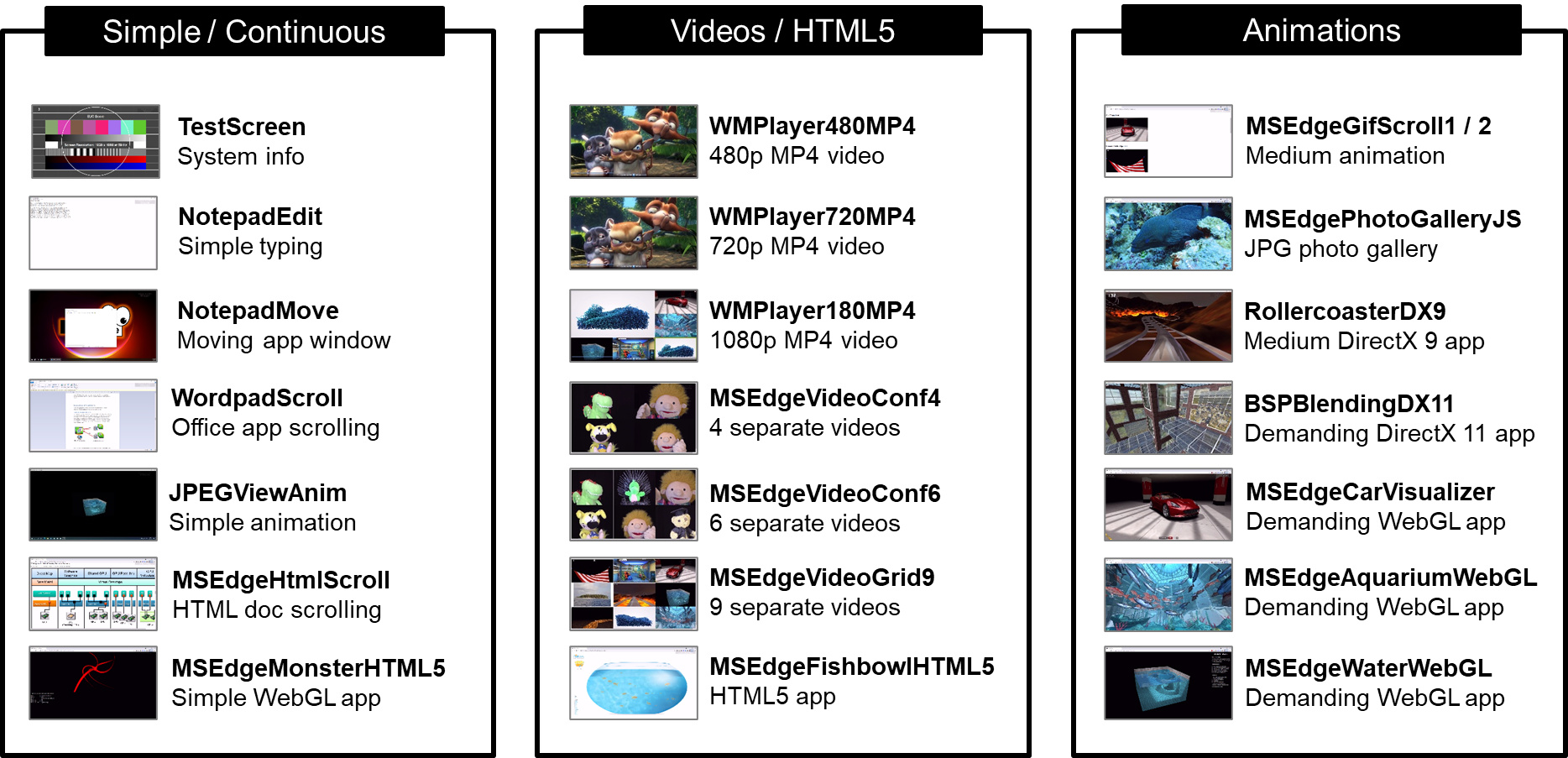
The image below shows the list of the synthetic workloads (Simloads) used.
Systems Under Test (SUT = VM Profile)
With Dizzion Frame, getting access to a Cloud PC took only minutes. Setup, VM cloning, session configuration, creating new accounts and launching the FRP user session directly from the browser were all super simple. The temporary RDP connection was initiated on the same virtual machine by enabling "RDP Debug" in the Dizzion Frame console. The virtual machine used for testing the Citrix Cloud PC is independent of the Dizzion VM, but has the same specifications.
Network Profiles (using an Apposite Linktropy Mini2 WAN emulator)
NOTE: In this project setup, the Internet round trip time between the EUC Score test lab and the cloud datacenter is approx. 10ms. This means that adding 50ms latency to both the upstream and the downstream results in a total round trip time of 110ms. The maximum bandwidth is limited to 100 Mbit/s by the WAN emulator to guarantee fair test conditions over a longer test period. On average, a packet loss percentage of 2% or lower over a 10-minute timeframe is considered an acceptable level. However, the unconstrained Internet connection between the EUC Score test lab and the nearest cloud datacenter shouldn't see packet loss at all.
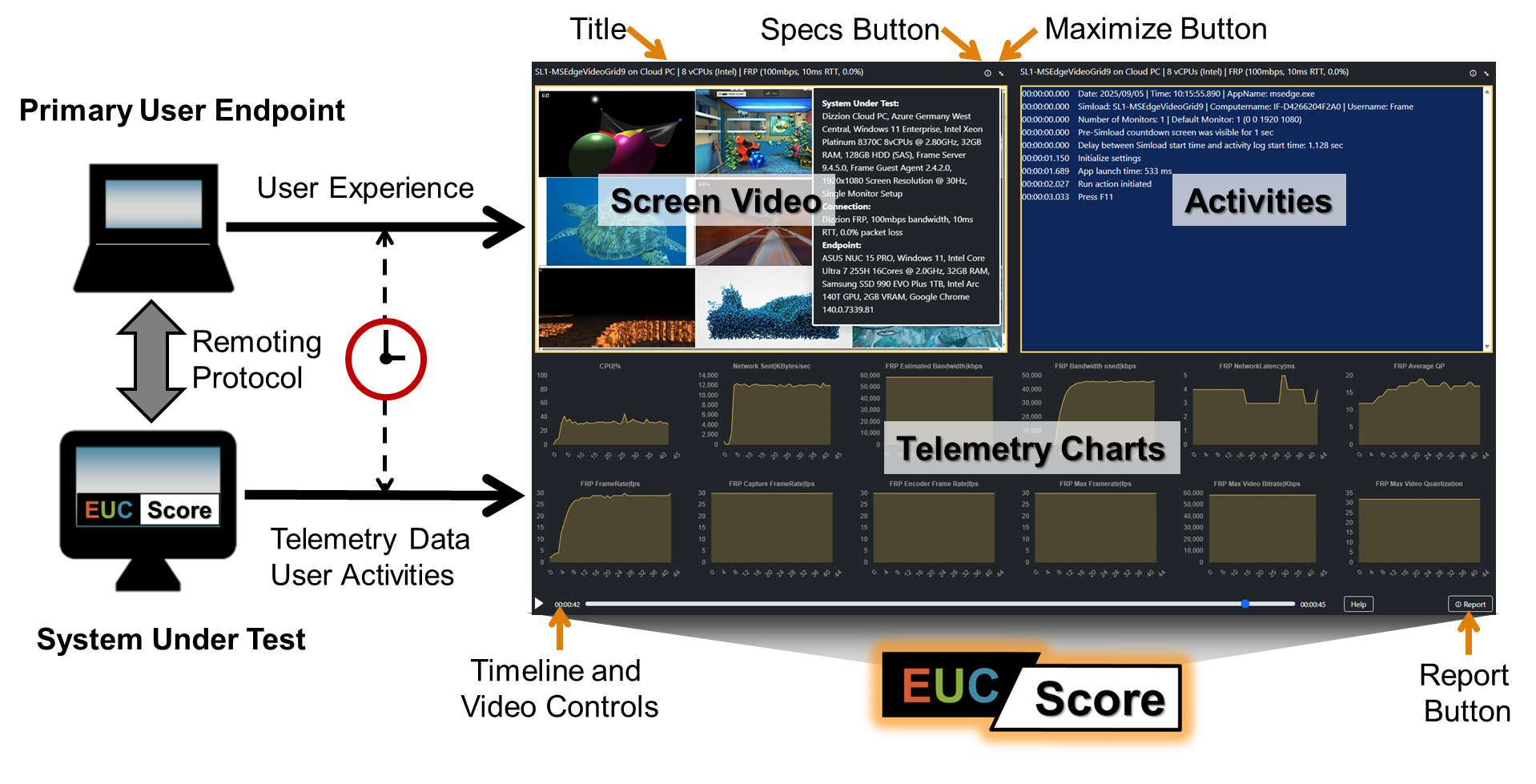
Each workload was run on all three systems under test and under all network profiles, and the associated test data sets were archived. The test results were visualized using the EUC Score Sync Player (see image below), which allows for further analysis.
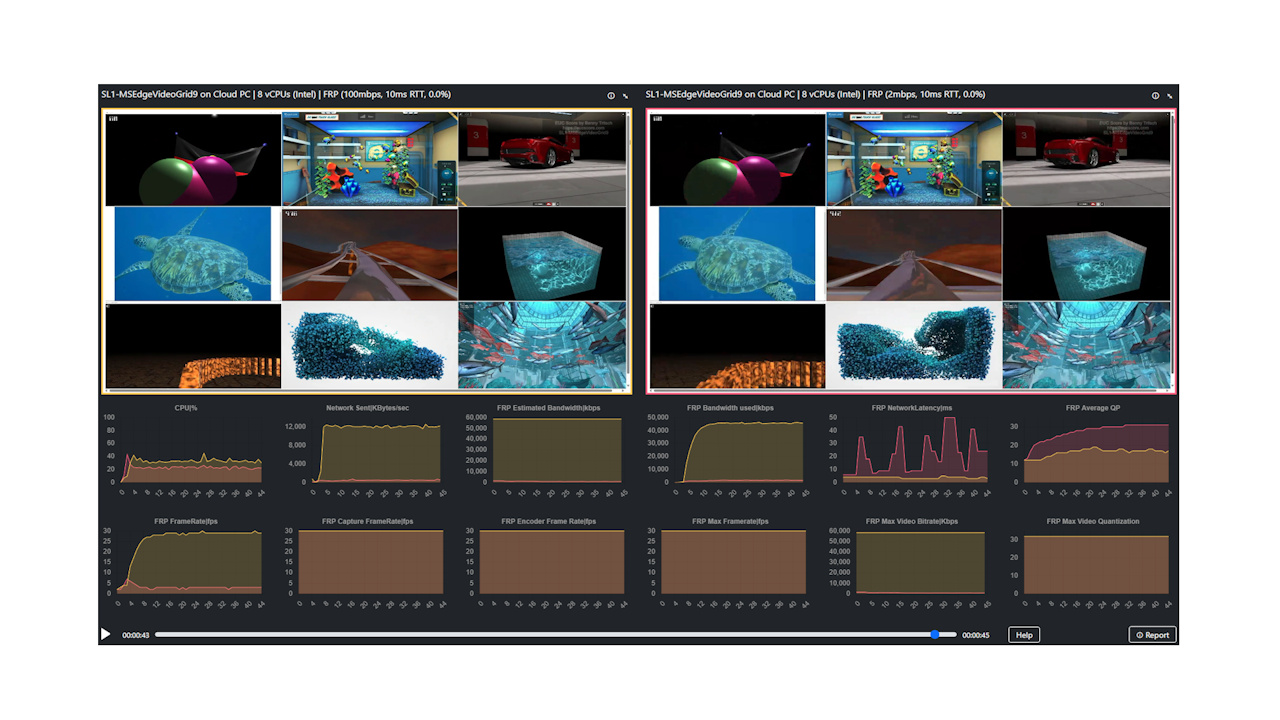
At the end of the project, the results of more than 500 individual test runs and a significant number of side-by-side comparisons were available. To view sample test results, click on a link in the list below that will take you to a selection of EUC Score Sync Player clips in side-by-side mode used to visualize and compare the screen videos and performance data sets of two different test runs.
The test results clearly show how the change in network conditions influences the visual quality of Dizzion Cloud PC sessions connected via FRP. A higher amount of packet loss introduces stuttering in animations and videos. Adding a higher amount of network latency doesn't have an impact on graphics quality, but due to the higher user interface response times it's much harder for a user to interact with the desktop and the apps. Reducing the network bandwidth results in compression artifacts and reduced frame rates in many test workloads.
FRP versus RDP: Without network constraints, many workloads don't show a big visual difference between FRP and RDP11. In some cases, RDP requires less bandwidth than FRP, but there are exceptions. In some workloads, FRP shows better image and animation quality. FRP is better able to handle packet loss. Even with increasing latency, FRP shows good performance, but often requires more bandwidth. Low network bandwidth also poses no problems for FRP. Compared to RDP, FRP generally offers better image quality under low bandwidth conditions. Across almost all workloads and regardless of network conditions, the FRP session requires more CPU capacity than the RDP session.
FRP versus HDX: Without network constraints, most workloads don't show a visual difference between FRP and HDX. In most cases, HDX requires less bandwidth than FRP, but there are exceptions. Under limited network conditions, most FRP test runs also show better image and animation quality, but higher bandwidth requirements. With few exceptions, there is no significant difference in CPU capacity requirements when workloads run in either an FRP or an HDX session.
Important: The test results for Citrix for Windows 365 collected during this project are underwhelming. The reasons for this are not yet entirely clear. Further reference tests using the HDX protocol will be conducted in the near future to verify the results.
This benchmarking test shows that the Dizzion FRP protocol adapts automatically to varying network conditions and demonstrates good performance. Graphics and animation quality in FRP sessions is very good. However, this comes at the expense of bandwidth requirements, which are often higher for FRP than for comparable protocols.